Automated Phone Calls With Voice AI Agents
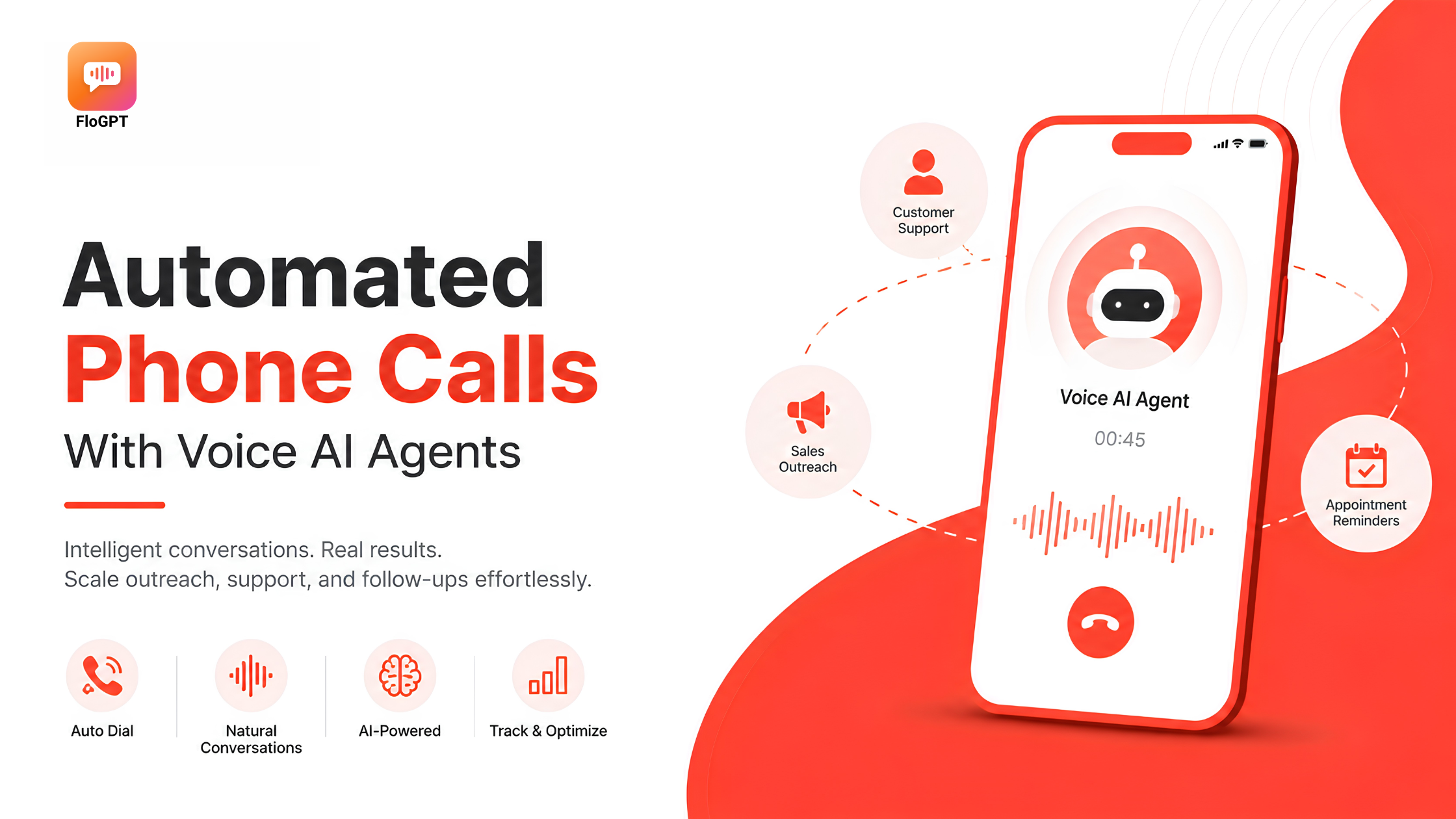
Learn how Voice AI agents automate phone calls, improve customer support, reduce wait times, and provide 24/7 assistance.
Let's face it, no one wants to call support.
You punch numbers into your phone, work through a complex phone menu, are put on hold, describe the problem, get transferred to another department, and describe the problem all over again.
Businesses aren't having it much better. Support reps are stretched thin, the number of calls vary widely from day to day, and staffing additional reps isn't always an option.
This is where Automated Voice calls powered by Voice AI agents are getting so much attention.
They're not new in the sense that Automated Phone Systems have been around for ages, it's the fact that current Voice AI agents can actually hold conversations.
These systems don't have an automated menu that says 'Press 1 for Sales.' The systems can actually listen to what customers are saying and respond to help answer questions in real time.
They have reached a level that some customers cannot even identify that they are speaking to an AI.
What are Voice AI agents, and why are so many businesses eager to adapt them?
Let's investigate.
What Are Voice AI Agents?
A Voice AI agent is the technology behind a phone call to a natural speech conversational AI system.
Instead of navigating complex, robotic, predefined menu structures, Voice AI leverage speech recognition, natural language processing, and language models to engage in a conversation with the caller, and deliver a conversational response back over the phone.
This is like comparing the difference between speaking to a 20 year old telephone answering machine with pre-defined messages or an interactive voice response (IVR) system to speaking to a human customer support agent.
While an IVR system follows rule-based scripts, a voice AI system can be described as being conversational. This difference in approach becomes critical when we consider how callers might express themselves to the AI agent.
If the caller says, "I'd like to reschedule my appointment for sometime next week", a voice AI agent can understand the user's intent and carry on a conversation instead of requiring the caller to wade through numerous menus to make their desired changes to their existing appointments.
Why Businesses Are Turning to Voice AI
There are a couple of huge reasons:
Customers want it to be fast.
They aren’t willing to wait twenty minutes for their most basic questions to be answered – they need to be helped instantly, whether it's to check their order status, make an appointment, or update account information.
Voice AI helps companies answer these common tasks without human intervention on each call.
This doesn’t mean replacement, of course.
It means that human agents can assist customers with much more complex issues while AI takes care of the rest. Most often, everyone benefits.
Customers receive quicker answers. Human agents have fewer of the same boring tasks, and the business runs more effectively.
Common Use Cases for Automated Voice AI Calls
Voice AI is showing up in more places than many people realize.
Appointment Scheduling
Healthcare practices, hair salons, repair shops and other appointment-driven businesses can face overwhelming numbers of calls to manage appointments.
Voice AI agents can manage:
- Reservations/bookings
- Confirmations
- Cancellations
- Reminders
...without human interaction.
Customer Support
Many of the support requests received are also surprisingly simple to predict. For example, common customer inquiries include:
- Where is my order?
- What are your business hours?
- How do I reset my password?
- What is my account balance?
A voice AI could handle the instant answering of these inquiries while triaging complex issues to human agents.
Lead Qualification
Sales reps spend valuable time deciding whether a lead is the right fit.
Voice AI agents can start conversations, ask questions, collect data and route high-potential prospects to the correct sales reps.
Collections and Payment Reminders
Most companies use automated voice messages to notify consumers of an upcoming payment or delinquent bill.
A voice AI would be able to have a much more conversational and interactive experience than current robocalls.
The Biggest Advantage: Availability
- Human agents get tired.
- Voice AI doesn't.
- It can handle calls 24/7.
If you operate in more than one time zone, it can be a lifesaver.
Consider a customer with a simple query at 11pm. They might otherwise have to wait until the following morning to find out the answer.
With Voice AI, they get the response straight away. This level of convenience cannot be underestimated.
But Do Customers Actually Like Talking to AI?
The answer? It depends.
Your customers don't necessarily care about whether or not they are interacting with a human being. They care about solving their problems, quickly and efficiently.
And frankly, if an AI understands and responds promptly and accurately, people often don't care one bit about talking to a machine.
Problems only develop when the technology doesn't work the way we've become accustomed to expecting.
You know those Automated Systems that perpetually misunderstanding "representative" and "customer service"?
Those interactions foster an air of skepticism. It's why the quality of automation is much more important than the automation itself.
A Voice AI that cannot understand customers, it would only generate frustration.
The Challenges Businesses Should Consider
Voice AI is not an exception to this rule. Any technology comes with its limits and Voice AI is no exception.
Understanding Complex Requests
Not all customer problems are as simple, but can involve sensitivity, feelings, or a specific, one-off problem.
An AI could face difficulties in conversations that are extremely complicated.
Human escalation is still needed.
Maintaining Accuracy
Using outdated data can lead to wrong answers from the AI. This is crucial when discussing prices, policies, and account specific information.
Customer Trust
Transparency is required when businesses let their customers talk to the AI.
It does not make sense to try and hide that you are speaking with the AI.
Most consumers want to know.
How Voice AI and Human Agents Work Best Together
The best companies aren't picking between AI and human.
They are bringing both to the table.
Voice AI helps automate simple and repeatable tasks and gather data to fulfill straightforward customer inquiries and requests.
Human agents are the specialists when empathy, decision-making, and more complex problem-solving abilities are required.
AI should be viewed as only a part of, not a complete, support solution, but with the right implementation, AI enhances the human agent rather than displacing him.
What the Future Looks Like
Voice AI is getting better very fast.
The conversations feel much more natural.
Response times are quick.
The understanding is quite precise.
With each new iteration of language models, the conversation of human AI, becomes closer and closer to human speech.
This does not mean that every customer service interaction should be automated; it does mean that the business world is getting a powerful new weapon that can make it easier and faster to get customers the support they need.
Holding music and phone trees may not disappear completely, but for the first time in a long time it seems like there might be another way out of these frustrating customer experiences.
And businesses who want to get better service and grow without hiring additional people, may not be able to ignore automated calls with Voice AI assistants for much longer.